Before Building Custom AI, Start with SAP-Native Capabilities
A practical way to improve enterprise resource planning processes without duplicating technology, data, and cost

Artificial intelligence (AI) adoption is now mainstream. McKinsey’s 2025 global survey found that 88% of respondents reported regular AI use in at least one business function. SAP also reported in 2026 that more than 34,000 customers globally already rely on SAP Business AI capabilities embedded across its cloud portfolio. For organizations whose core operations already run on SAP enterprise resource planning (ERP) systems, this raises a practical question: should every process problem lead to a new standalone AI platform, or should teams first examine what is already available in their SAP environment?
Start with the Process, Not the AI Product
The starting point should be the actual pain points experienced by SAP users, such as:
- Repetitive manual activities
- Delayed approvals
- Difficult information retrieval
- Time-consuming reporting
- Limited forecasting and decision support
- Complex navigation
- Inconsistent data entry
- High volumes of employee or supplier enquiries
Each pain point should be assessed against the simplest effective intervention before a new AI solution is introduced. The review should progress through the following options:
- Process simplification
- Existing SAP standard functionality
- SAP configuration and workflow automation
- Better reporting and analytics
- User guidance and training
- Embedded SAP AI and Joule capabilities
- A governed custom AI extension
Why SAP-Native AI Deserves First Consideration
SAP Business AI is designed to bring AI into established business processes using SAP data, process context, roles, and workflows. It includes embedded AI use cases, Joule assistants and agents, and tools for developing custom extensions through SAP Business Technology Platform (SAP BTP).
Starting with SAP-native capabilities can provide several advantages:
- Reduced integration and implementation complexity
- Better alignment with existing SAP processes and controls
- Reuse of established roles and authorizations
- Less duplication of enterprise data
- Simpler support and lifecycle management
- Greater value from existing SAP investments
For common ERP process improvements, this route may be more efficient than building and operating a separate AI platform. However, the business case must still be validated. Licensing, implementation effort, integration, data readiness, security, and total cost of ownership (TCO) should be assessed for the specific SAP product, deployment model, release level, configuration, and commercial arrangement.
Do Not Use AI to Compensate for Weak Foundations
AI should not be used to mask weak process design, poor data quality, incomplete configuration, unnecessary customization, or insufficient user training. Automating a broken process usually makes the problem faster and harder to govern.
Before approving an AI initiative, business and technology teams should confirm:
- The business problem and desired outcome are clearly defined.
- The underlying process has been simplified where possible.
- Required data is accurate, accessible, and appropriately governed.
- Existing SAP capabilities have been evaluated rather than assumed inadequate.
- Benefits can be measured against cost, risk, and operational impact.
When Custom or Third-Party AI Is the Right Choice
Custom or third-party AI may still be justified when:
- SAP does not provide the required capability.
- The use case spans several enterprise platforms.
- The organization has unique business or industry requirements.
- Greater control over models, data, or deployment is required.
- SAP capabilities do not meet language, compliance, or usability needs.
- The SAP commercial model is not viable.
- The capability provides genuine strategic differentiation.
Where customization is required, it should preferably be delivered as a governed extension that protects the ERP clean core, rather than as a complex modification to the underlying SAP system.
A Practical Decision Principle
Use SAP-native AI where it adequately improves an existing SAP process. Build custom AI only where there is a clear functional, strategic, technical, or commercial justification.
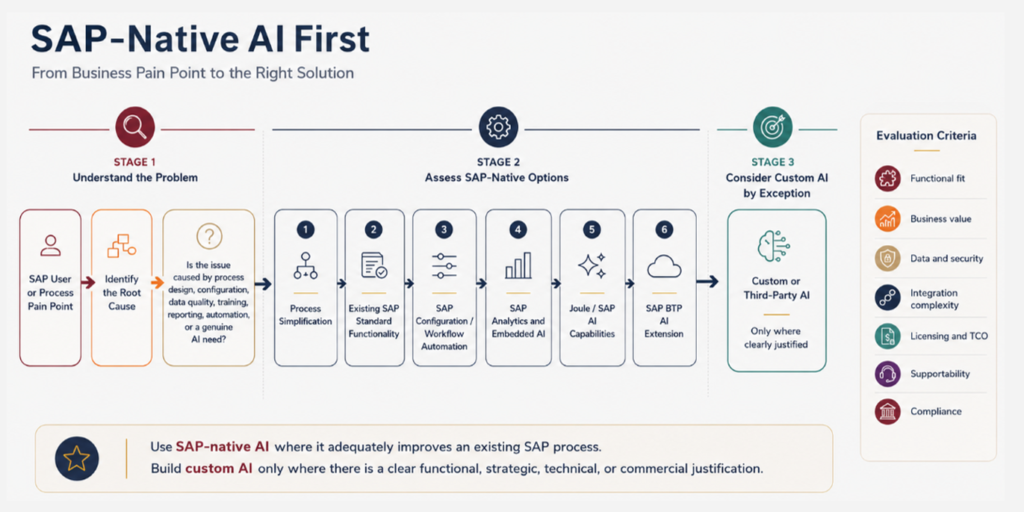
This principle connects AI investment to real business pain points, protects existing technology investments, and reduces the risk of disconnected solutions that duplicate capabilities already available within the SAP ecosystem.
Sources and Further Reading
- McKinsey & Company, “The State of AI: Global Survey 2025”
- SAP, “SAP Labs to Hire and Train AI Scientists and Machine Learning Engineers in Partnership with IMDA”
- SAP Business AI and Joule
- SAP Learning, “Explore How Customers Benefit from Out-of-the-Box and Custom AI”
- SAP Learning, “Building Custom SAP Business AI Solutions”
Conclusion: Treat AI as Process Improvement, Not Platform Acquisition
An SAP-native-first approach does not mean “SAP only.” It means using the most efficient and governable layer first, then escalating to custom AI when the business case is clear. This protects the clean core, reduces duplication, and directs investment toward measurable operational outcomes rather than technology for its own sake.
Ready to identify practical AI opportunities in your ERP landscape? Weigh your pain points against SAP-native capabilities first, and build custom only where there’s a clear justification. SOLGulf works with enterprise SAP teams on exactly this kind of assessment — talk to us to get started.
About the Author

Principal Enterprise Architect, SOLGulf
Bilal Ahmed is a Principal Enterprise Architect with more than 20 years of experience across enterprise architecture, digital transformation, cloud, and solution delivery. His work focuses on translating business priorities into governed technology decisions, particularly for government and regulated environments.